GHC’s solution architect and the AI-Native key to a million-dollar opportunity
Behind the million-dollar opportunity from the Modernization project lies the ability to turn technological capabilities into values that customers can see and trust. For Vu Tien Quy (GHC.HIS), an AI-Native mindset is one of the factors that creates that competitive edge.
With large-scale Healthcare projects, the challenge is not only about building a stable, secure system capable of long-term operation, but also about meeting customer needs accurately. In that context, the role of a Solution Architect goes far beyond designing system architecture. For Vu Tien Quy—Solution Architect for the FHG project and Technical Lead for the million-dollar project A. at GHC.HIS—every technical decision must start from the customer’s perspective to deliver practical value to the business problem.
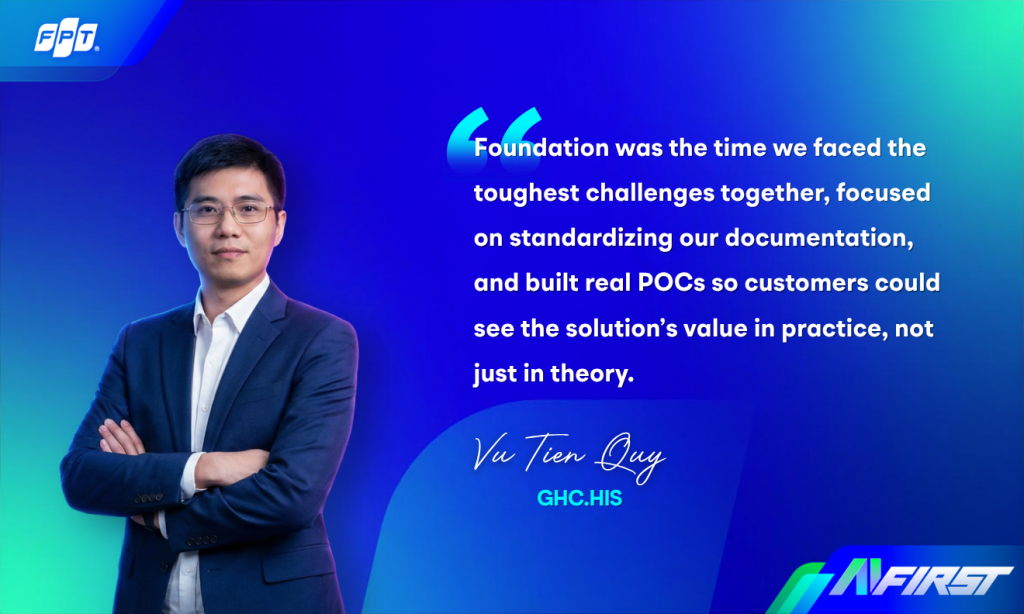
He has cultivated this spirit through the habit of learning and updating his knowledge every day. Coming from a Backend and Cloud background, he proactively explores new technology trends—especially AI—to broaden his perspective and strengthen his consulting capability. This continuous accumulation helps him confidently discuss, challenge assumptions, and propose solutions that fit each specific requirement.
According to Quy, technical capability only truly matters when it is realized through outcomes that customers can see. During the Foundation stage, he and the team focused on standardizing documentation and building POCs to turn ideas into concrete evidence. Looking back on that period, he shared: “Foundation was a stage where the whole team overcame many challenges together. The project team focused on standardizing documents and building specific POCs so customers could see the value of the solution in practice, rather than it remaining only theoretical.”
The results achieved during the Foundation stage helped strengthen customer trust, enabling FPT to pass technical evaluation rounds and successfully continue with phase 2A at a scale of 41 members combining onsite and offshore. Throughout the system development process, Quy and the team consistently followed one principle: solve the right problem with a simple and effective approach. In his view, the value of a solution is not in the complexity of the technology, but in its ability to meet real needs and maintain long-term flexibility. This approach also helps reduce the risk of over-engineering while enabling developers to quickly take ownership of the system.
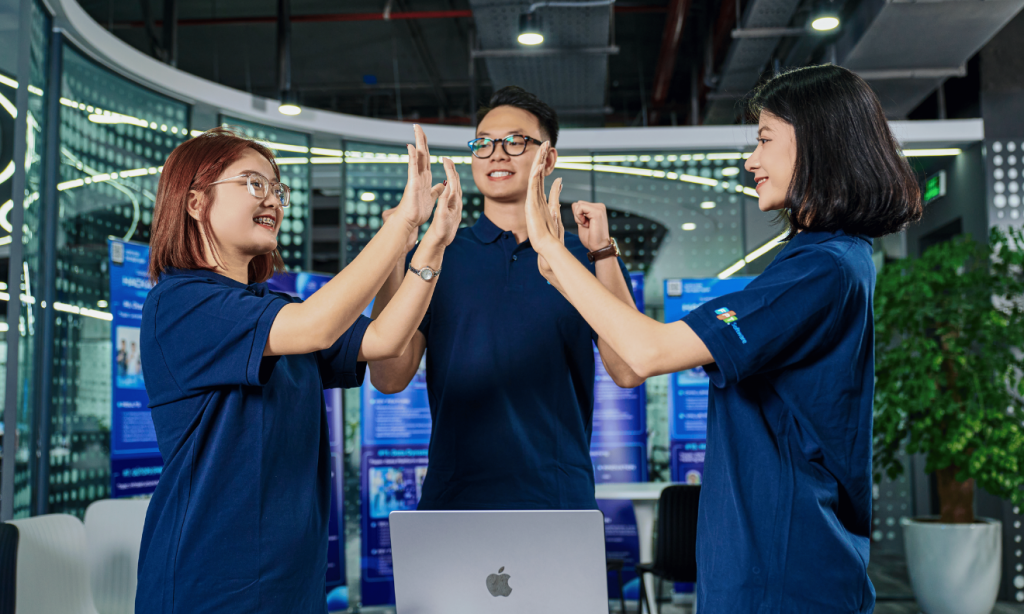
This pursuit of optimal ways of working led Quy to an AI-Native mindset. Instead of viewing AI as merely a tool, he chooses to leverage AI as a collaborator in brainstorming, planning, and execution. Currently, he uses Claude Sonnet and Opus to analyze inputs, develop approaches, and organize work. Even so, he believes that domain expertise, critical thinking, and practical experience remain the decisive factors in solution quality. The greatest value comes from combining the power of AI with the engineer’s capability.
After leaving his mark on large-scale Healthcare projects, Quy aims to go further than system design. He wants to gain a deeper understanding of the domain and business strategy so he can accompany customers in comprehensive digital transformation programs. At the same time, he also hopes to build a strong successor team, solid in both technical and domain knowledge, ready to embrace new opportunities in the future.