FPT EVP Pham Minh Tuan proposes “technology passport” mechanism between Vietnam and India to enable cross-border AI engineering work
“Instead of competing head-on in the race to build gigantic AI models that cost billions of U.S. dollars, Vietnam and India can absolutely work together to develop specialized AI models for each industry and domain to serve global customers.”
That was the proposal put forward by Mr. Pham Minh Tuan, FPT EVP and FPT Software CEO, at the Vietnam–India Innovation Forum held on May 6 in New Delhi, as part of the State visit to India by General Secretary and President To Lam.
According to FPT’s leadership, as AI and semiconductors reshape the global technology value chain, Vietnam–India relations are not limited to traditional friendly cooperation, but stand at an opportunity to become a “strategic technology alliance,” enhancing self-reliance and rising in global tech competition.
Mr. Tuan also noted that Vietnam is emerging as a gateway connecting Northeast Asia and Southeast Asia, amid a clearer trend of manufacturing and technology R&D shifting to Vietnam. With deep understanding of local markets and a broad customer network in the region, FPT is currently accompanying most leading corporations in Northeast and Southeast Asia on their digital transformation and technology innovation journeys.
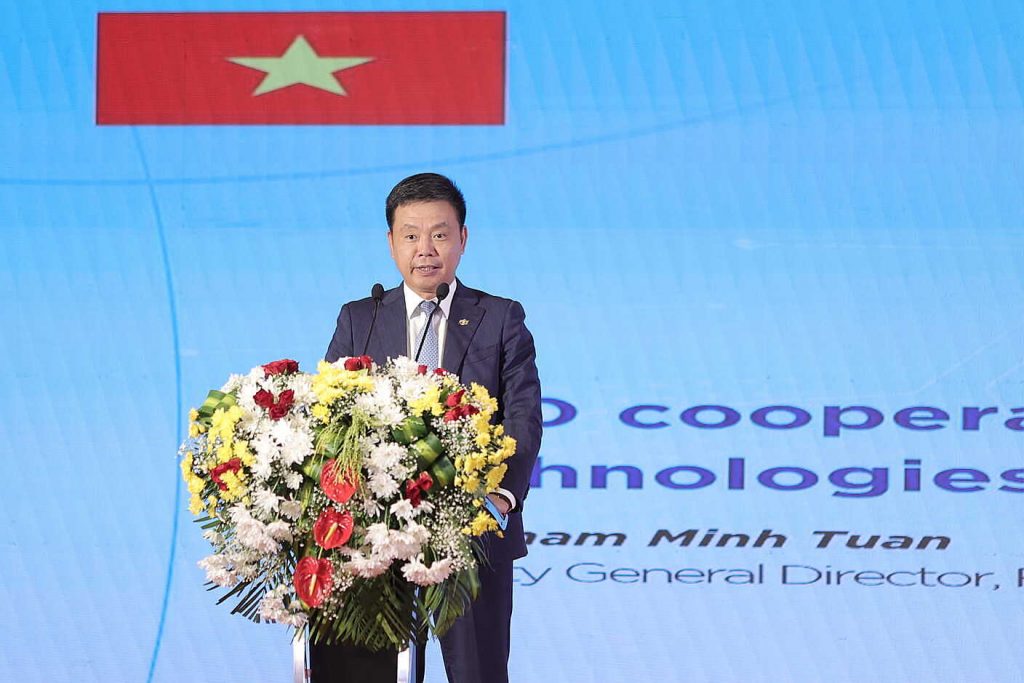
FPT’s proposal came as senior leaders of the two countries recently held high-level talks and agreed to promote linkages between security and development, and to expand cooperation in strategic technology areas such as artificial intelligence, digital transformation, innovation, energy, and training of high-quality human resources.
In particular, in a policy speech at the Indian Council of World Affairs, General Secretary and President To Lam outlined five key directions for Vietnam–India cooperation in the coming period, in which upgrading and accelerating cooperation in science, innovation, and strategic technologies is viewed as a vital pillar of bilateral relations.
The General Secretary and President assessed that knowledge, technology, and innovation have become the main drivers of growth and new factors determining overall strength and national competitiveness, requiring deeper and more diverse forms of cooperation in future-shaping areas such as the digital economy, data, semiconductors, and artificial intelligence. The two sides can promote cooperation not only at the level of orientation, but also in execution—by clearly identifying spearhead areas and implementation models; establishing cooperation programs among research centers, universities, and enterprises; and linking these with training and mobility of high-quality human resources between the two countries.
At the forum, the FPT EVP and FPT Software CEO said Vietnam and India share many similarities in their aspiration to master strategic technologies such as AI, semiconductors, and quantum technologies. While India is aiming to become the world’s AI hub with advantages in workforce scale and technology development experience, Vietnam also identifies AI as a core growth driver of the economy in the next phase.
Building on the strengths and advantages of both countries, FPT’s leadership proposed that in AI, instead of direct competition in building extremely large-scale foundational AI models, the two countries could cooperate to form a “Deep AI Application Alliance” for industries such as finance, manufacturing, healthcare, and telecommunications. The alliance’s differentiator would be its ability to customize for culture, language, and the specific needs of each enterprise and market.
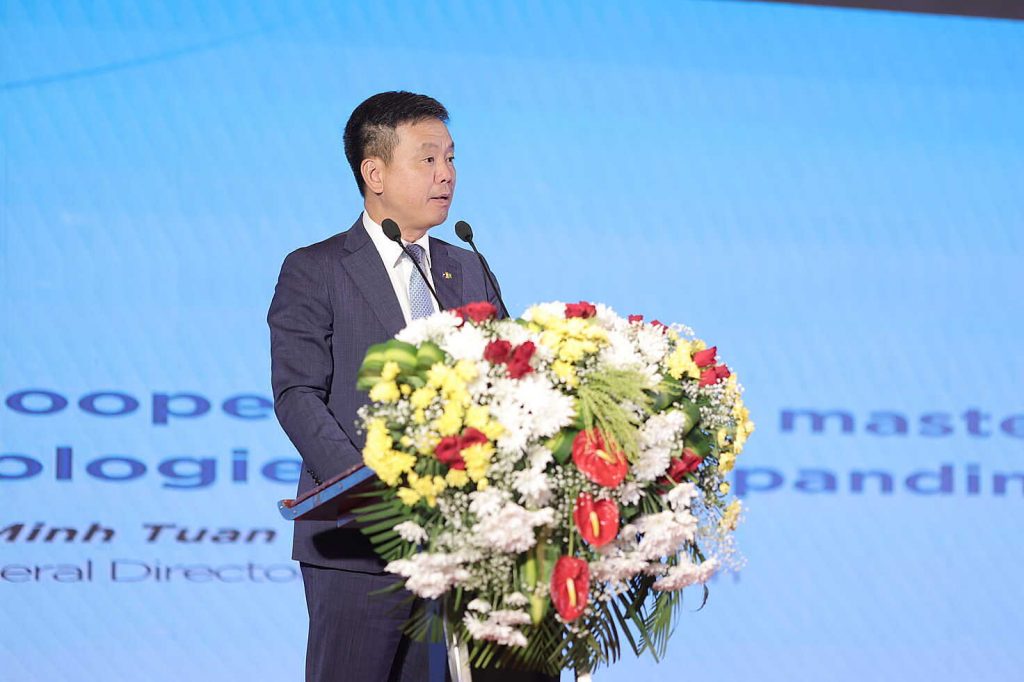
Mr. Pham Minh Tuan also proposed that the two countries promote a more flexible mechanism for technology workforce exchange—like a form of “technology passport”—enabling engineers from both sides to participate in cross-border projects and share high-quality resources.
Beyond AI, FPT also presented several other proposals for Vietnam–India cooperation in strategic technology fields.
In semiconductors, Mr. Tuan proposed that the two countries form complementary supply chains: India could focus on design and wafer fabrication, while Vietnam strengthens capabilities in advanced packaging and semiconductor testing (OSAT). This model is considered aligned with current development directions of both countries and helps optimize each side’s distinct advantages.
In railway technology and UAVs, FPT’s leadership proposed that the two countries share open platforms, simulation labs, and deploy pilot projects for UAVs integrated with on-device AI processing to serve agriculture, surveillance, and industry.
Another focus emphasized by FPT is the training of strategic-technology human resources. The company proposed expanding existing joint training programs, increasing student exchanges, and creating conditions for students in both countries to intern in areas such as software, AI, and semiconductors.
According to Mr. Pham Minh Tuan, Vietnam’s greatest advantage lies in flexible execution capability, fast adaptation speed, and ASEAN’s promising innovation-testing environment. Meanwhile, India possesses a large market and a workforce of around 6 million engineers and IT experts, regarded as one of the world’s major technology centers. This complementarity could create new growth momentum for both economies.
FPT’s representative also devoted significant time to discussing the group’s technological capabilities and global experience. FPT currently masters multiple layers of the AI value chain with 70 specialized AI models for professional domains, two AI factories in Vietnam and Japan, and a team of about 30,000 engineers enhanced with AI capabilities. In semiconductors, the company has trained more than 3,300 students and has nearly 1,000 chip design and embedded software engineers.
FPT is present in more than 30 countries with employees of 82 nationalities. Notably, FPT’s first steps into the international market were in Bangalore, India in 1999. Today, Indian employees are the third-largest workforce at FPT by scale, after Vietnamese and Japanese employees.
According to many experts, as Vietnam and India become increasingly aligned in development vision and strategic priorities, areas such as AI, innovation, and digital transformation are expected to become new pillars of cooperation between the two countries in the coming period.