
SAS demonstrates it’s capabilities at the world’s largest cybersecurity event, Standoff 15
Standoff 15 brought together cybersecurity experts from around the globe to compete in the virtual battleground of State F. Organized by Positive Technologies, the event not only tests participants’ cyber defense and offense skills but also helps enterprises strengthen their ability to protect systems against real-world security threats. Recently, SAS participated in the competition and secured a spot in the Top 11 out of nearly 40 teams.
Since its launch in 2016, Standoff has attracted over 5,000 experts and 500 companies worldwide. The event simulates operational processes from various industries, including IT, banking, oil and gas, and energy. To win, teams must showcase their abilities in two main roles: Red Teams (attackers) and Blue Teams (defenders).
In their first appearance at Standoff, SAS’s team—SAS.SWORD—entered the arena with a lineup of 10 hackers. Competing as a Red Team, SAS.SWORD faced the challenge of identifying and exploiting vulnerabilities in simulated IT systems from a range of industries. Their mission wasn’t just to discover flaws but also to carry out simulated attacks to assess the systems’ resilience.
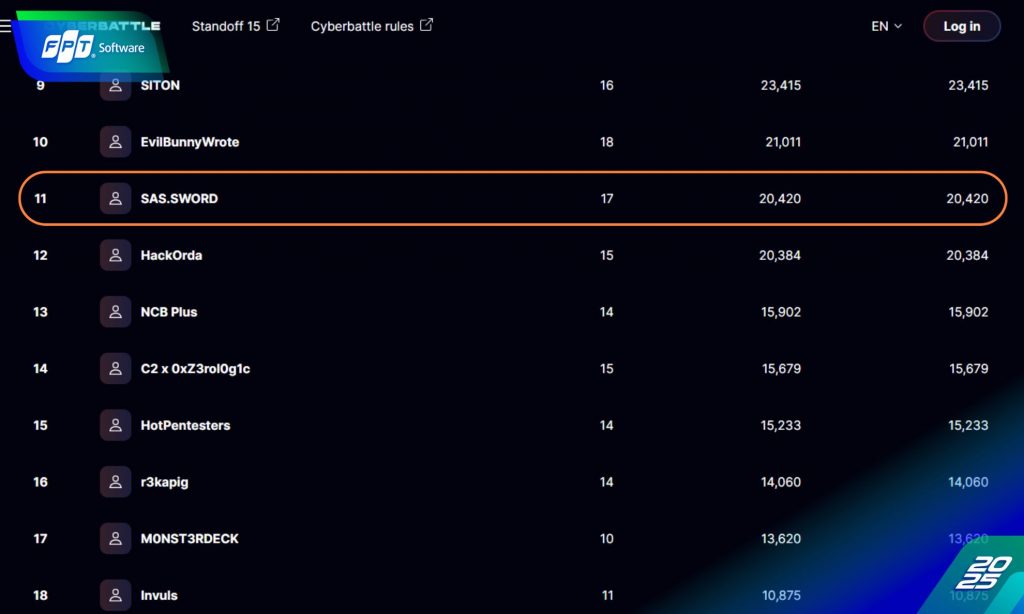
After five intense days of competition, SAS.SWORD climbed to top positions, including Top 6 and Top 8, thanks to sharp, strategic attacks. However, the team also encountered technical difficulties—especially in the online competition environment—facing unstable internet connections and moments of frustration when they discovered flags but couldn’t submit them before the time expired.
Ultimately, SAS.SWORD concluded their journey at Standoff 15 with an impressive Top 11 finish out of nearly 40 teams—an encouraging result for a young team making their debut at an international tournament.
More than just a competition, Standoff 15 was a valuable opportunity for SAS members to challenge themselves, learn new strategies, and strengthen their teamwork. Through this event, SAS not only reinforced its technical capabilities but also forged meaningful connections with the global cybersecurity community—laying the groundwork for future challenges and achievements.