Embrace ‘Memory in Lean Reinforcement Learning’ with PhD from Australian University
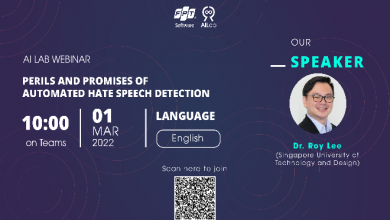
At 10 am on April 13, FSOFT AI Center will hold an internal knowledge sharing webinar called “Memory for Lean Reinforcement Learning”. The participating audience will join Dr. Hung Le (Deakin University) to delve deeply into memory in Lean Reinforcement Learning.
📌 Register to attend the webinar HERE
Despite great successes in breaking human records, reinforcement learning training is currently very expensive in terms of time, GPU, and samples. They typically require hundreds of millions or even billions of steps to achieve human-level performance in the Atari game.
The problem of undersampling inefficiencies becomes more serious in stochastic, partially observable, noisy, or long-term real environments, but conversely, humans can exhibits excellent performance in these cases without too much training. That lack of reinforcement learning agents may be due to the lack of effective human-like memorization mechanisms that promote learning by making intelligent use of concepts observation and past experience.
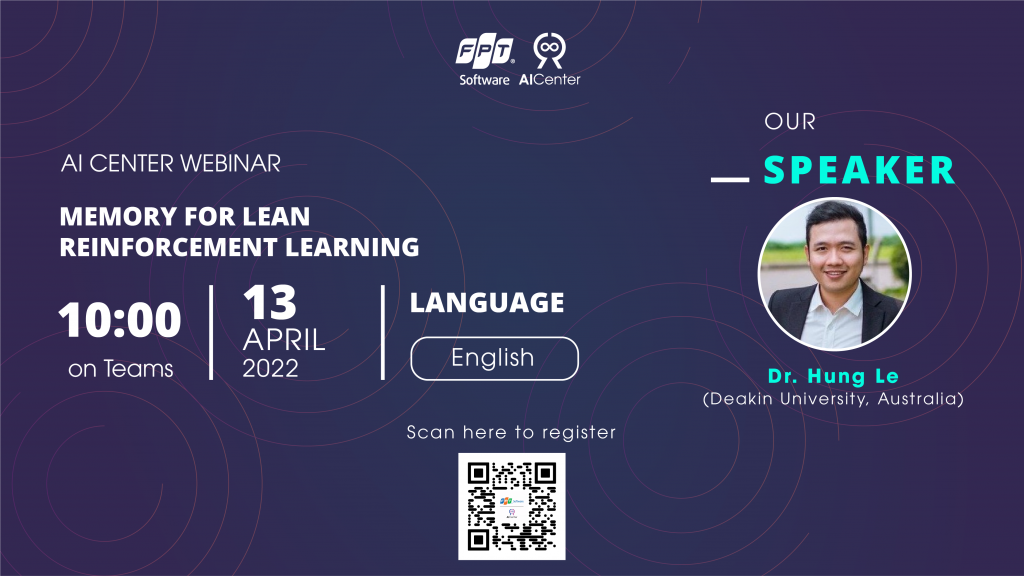
In this webinar, we will be discussing in-depth the recent advances in memory-based reinforcement learning, where emerging memory systems allow reinforcement learning agents to become efficient, adaptive and human-like.
Dr. Hung Le graduated with a Bachelor of Science in Engineering from Hanoi University of Technology in 2015. In 2020, he completed his PhD in Computer Science at Deakin University, Australia. He is currently a research lecturer at Deakin University and a member of the Applied Artificial Intelligence Institute (A2I2), where he works on various topics in machine learning, deep learning, and artificial memory. In particular, he wishes to invent new deep learning models with access to artificial neural memory. He created a research group to advance the field that includes multimodal memory, general memory, theoretical foundations for memory operations, general-purpose neural computing, and reinforcement learning. Their application areas include health, conversational systems, reinforcement learning, machine inference, and natural language processing. He owns many research papers on machine learning, reinforcement learning and artificial intelligence published at world-leading conferences such as ICLR, NeurIPS, ICML, AAAI, KDD, AAMAS, ICPR, ICONIP and PAKDD.
At the webinar, AI Center will give a gift worth 200 gold to one audience who asked the best question and one lucky spectator selected at random.